

Cultivating Self-Compassion When Life Gets Heavy
There are moments when the bottom drops out. We’ve all been there - sitting in the wreckage of a failed project, navigating a sudden loss, or just grinding through a stretch of relentless, soul-crushing difficulty. In these times, the natural inclination, for many of us, is to reach for the nearest stick and start beating ourselves up. We replay our perceived failures, internalize the negativity, and tell ourselves some version of: “I should have known better,” or “I’m not strong enough to handle this.”
It’s a bizarre, almost primal reaction: when we need kindness the most, we default to cruelty. And yet, if a dear friend were sitting across from us, tears welling up over the exact same situation, we wouldn’t dream of offering them a harsh critique. We’d offer a soft blanket, a hot drink, and a simple, genuine assurance: This is hard. I see you. You’re going to be okay.
This, right here, is the core of self-compassion, and it is the single most powerful tool we have for staying positive - or, perhaps more accurately, for staying resilient - when things are truly hard.
For years, I believed that my inner critic was a necessary motivator. I thought that if I wasn’t constantly driving myself with a whip, I’d become lazy, complacent, and ultimately fail. This idea is a pervasive myth in our culture: that high performance requires high self-criticism.
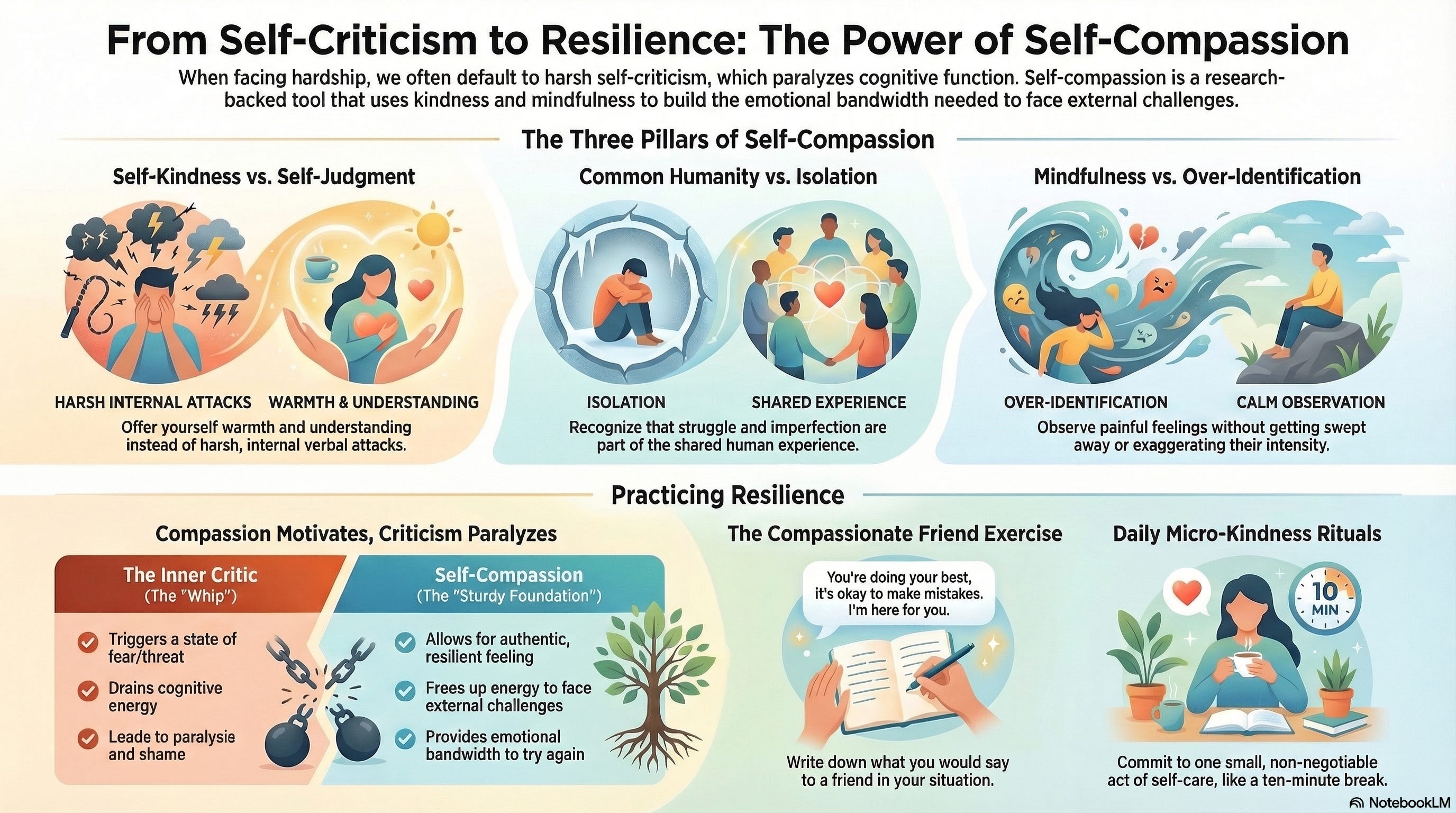
The truth, as decades of psychological research now show, is the exact opposite. Self-criticism paralyzes; self-compassion motivates. When we fail and immediately jump to attack mode, our brains shut down. We enter a state of fight-or-flight, focused only on protecting ourselves from the internal threat. This drains cognitive energy, makes problem-solving impossible, and certainly doesn’t foster a “positive” outlook. It just creates fear.
Self-compassion, on the other hand, is the practice of acknowledging your pain without adding layers of self-judgment. It’s built on three interconnected pillars, articulated brilliantly by researcher Dr. Kristin Neff:
Self-Kindness vs. Self-Judgment: Instead of harsh criticism, we offer warmth and understanding to ourselves.
Common Humanity vs. Isolation: Recognizing that suffering, failure, and imperfection are part of the shared human experience - you are not alone in your struggle.
Mindfulness vs. Over-Identification: Observing your painful feelings without getting swept away by them or exaggerating their intensity.
When you practice self-compassion, you’re not letting yourself off the hook; you’re simply giving yourself the emotional bandwidth necessary to get back on the hook. You’re giving yourself a sturdy foundation from which to tackle the problem, not another obstacle to climb over.
The instruction to “stay positive” when you’re drowning in difficulty often feels like a cruel joke. It suggests that you must mask or deny the very real pain you’re experiencing. That’s not sustainable, nor is it genuinely helpful.
Self-compassion offers a better way. It shifts the focus from enforced positive thinking to authentic resilient feeling.
Instead of forcing a synthetic smile and saying, “Everything is great!” when it absolutely is not, self-compassion allows you to lean into the discomfort and say:
“This truly sucks right now. I feel awful, and that is a valid human response.” (Self-Kindness & Mindfulness)
“Every person who has ever tried something difficult has felt this sting of disappointment. I’m not uniquely terrible; I’m just human.” (Common Humanity)
“What do I need right now to simply survive the next hour? A walk? A ten-minute cry? A cup of tea? I will give myself that without guilt.” (Self-Kindness in Action)
This is the path to genuine, lasting positivity - one rooted not in denial, but in self-acceptance and a clear understanding of your own needs. When you stop expending energy fighting your own internal state, you free up incredible energy to face the external challenge.
Cultivating this voice doesn’t happen overnight, but you can start today. Here are two simple practices:
The Compassionate Friend Exercise: The next time you find yourself struggling or failing, pause. Ask yourself: “What would I say to a dear friend facing this exact situation?” Write it down. Then, take a deep breath and read those words to yourself. The difference between the critic’s voice and the friend’s voice is often staggering.
The Micro-Kindness Ritual: Identify one small act of self-care you can commit to daily - even when the world is crumbling. This isn’t a spa day; it’s a commitment to your well-being. Maybe it’s drinking a full glass of water first thing, making sure you stand up and stretch every hour, or explicitly telling yourself, “I’m doing the best I can right now,” three times a day.
When life is hard, the goal isn’t to pretend it’s easy. The goal is to endure, to learn, and to emerge on the other side stronger and wiser. The most effective way to guarantee that outcome is not through gritted-teeth willpower, but through the gentle, unwavering power of treating yourself exactly as you would treat someone you love. Be your own advocate. Be your own soft place to land. It’s the most positive choice you can make.