

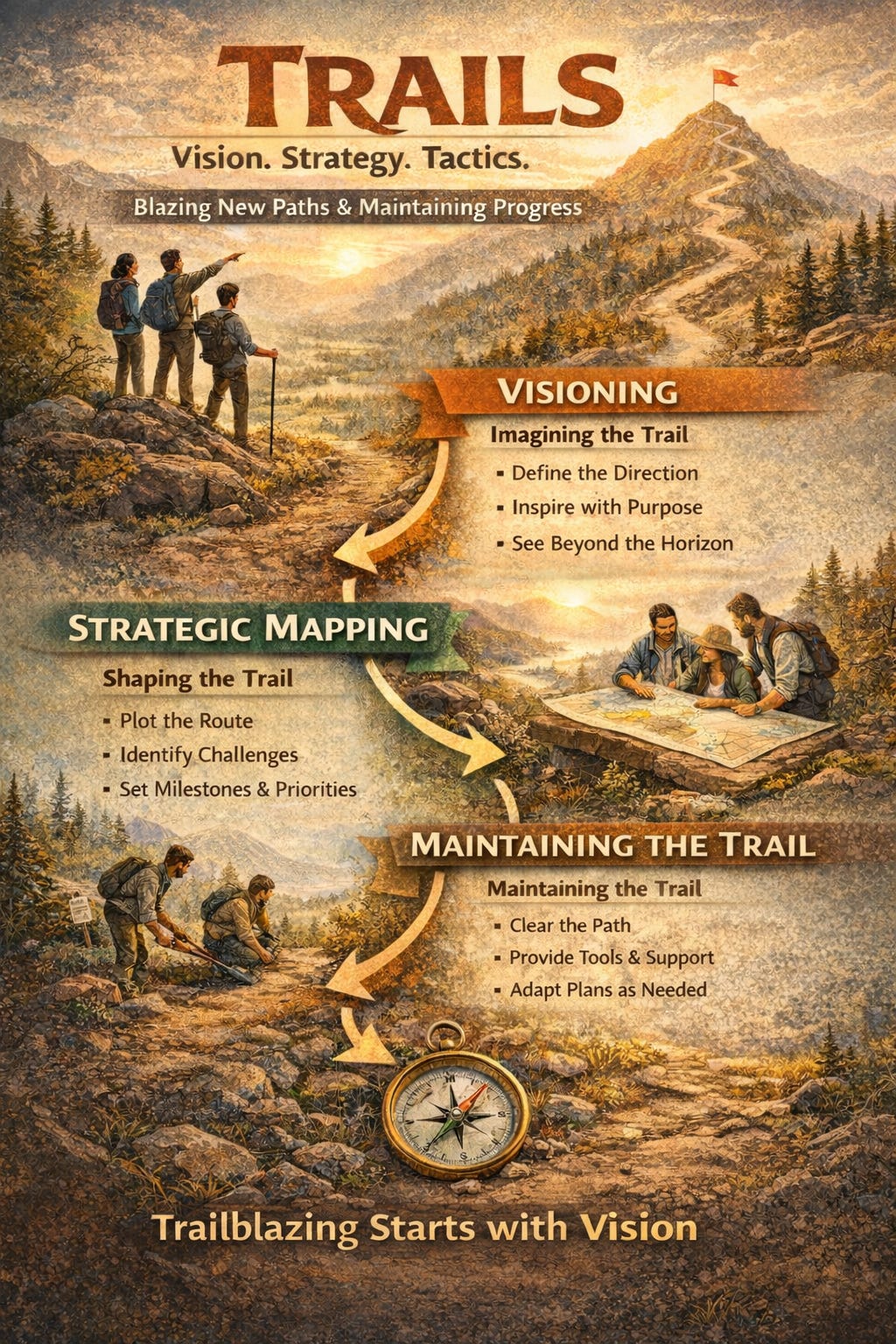
No meaningful work begins on a paved road. The paths that matter most are the ones that don’t yet exist - the ones we imagine before we ever walk them. Trailblazing starts with visioning. It is the quiet, courageous act of seeing what could be before there is evidence it can be done. Vision is not a detailed plan; it is a direction. It answers the essential question: Where are we trying to go, and why does it matter? Without vision, motion is just movement. With it, even uncertainty has purpose.
But vision alone doesn’t clear the brush. Once a direction is named, the trail has to be shaped. This is where strategic mapping lives. Strategy is the discipline of choice - deciding which terrain to cross, which obstacles to avoid, and which risks are worth taking. It translates aspiration into intent. A good map doesn’t promise an easy journey; it prepares you for the reality of the landscape. It acknowledges constraints, names milestones, and aligns people around a shared route forward.
Then comes the often-overlooked work: maintaining the trail. This is where tactics matter. Tactical plans are not glamorous, but they are what make progress sustainable. They are the daily decisions, the rhythms, the feedback loops, and the course corrections that keep the path usable over time. Trails disappear quickly if they’re not walked with care. Organizations stall not because the vision was wrong, but because the maintenance was neglected.
Healthy leadership holds all three together. Visioning sets the direction. Strategy shapes the path. Tactics keep it clear. Too much vision without planning becomes fantasy. Too much planning without vision becomes bureaucracy. Too much focus on tactics without either becomes exhaustion.
The leaders who make lasting impact understand this: trails are not found. They are made - deliberately, collaboratively, and with a commitment to tend them long after the first steps are taken.